Et 212 lab homework half-wave and full-wave rectifier..


Please review the following videos before getting started with this lab:

  1. Watch the video: “
  2. Watch the video: “
  3. Watch the video: “

Materials and Equipment:

Materials:

  • Simulated Parts (Multisim):
    • 30/3 Vrms center-tapped transformer
    • Two diodes 1N4001
    • Two 2.2 kΩ resistors
    • One 100 μF, 50 V electrolytic capacitor
    • One fuse (any rating is fine since it is for simulation only)
  • Hardware Parts (In the Toolbox):
    • Two diodes 1N4001
    • Two 2.2 kΩ resistors
    • One 100 μF, 50 V electrolytic capacitor

Equipment:

  • Virtual Instruments (Multisim):
    • Agilent Function Generator
    • Tektronix oscilloscope
  • Hardware Equipment:
    • Breadboard
    • NI myDAQ Instrument Device
    • Screw Driver
    • Screw Terminal connector
    • Jumper wires
    • Oscilloscope and Function generator from NI ELVISmx Intrument Launcher

Procedure:

***** This lab has to be implemented in both software (running simulations on Multisim) and hardware (using NI myDAQ) *****

Part A: Half wave rectification:
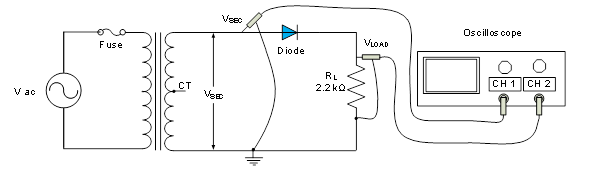
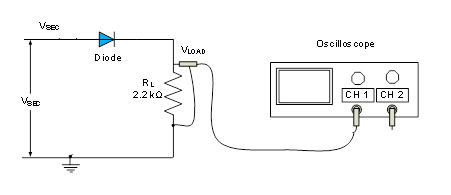
figure 1

Figure 1

Software (Multisim):

  1. Construct the circuit of a half-wave rectifier in Figure 1 in Multisim. Use a function generator to provide the AC input of Vacand use a center tapped transformer to obtain VSEC. Be sure to set the tolerance of the resistor to 20%.
  2. Connect the Tektronix oscilloscope so that channel 1 is across the transformer and channel 2 is across the load resistor (RL). Observe the waveforms VSEC and VLOAD.
  3. The output isn’t very useful as a dc source because of the variations in the output waveform. Connect a 100 μF capacitor (C1) with a tolerance of 20% in parallel with the load resistor (RL). (Note the polarity of the capacitor).
  4. Measure the dc load voltage, VLOAD, and the peak-to-peak ripple voltage, VRIPPLE, of the output. Measure the ripple frequency. Tabulate all data gathered and compare the results with and without the filter capacitor.

Hardware (NI myDAQ):

  1. Using the voltage VSEC obtained from the simulation, build the circuit in Figure 1 on the breadboard with VSEC as an input, which connects to the diode and load resistor RL in series. (See Figure 3)
  2. Using the jumper wires, screw driver and screw terminal connector, connect the board to NI MyDAQ Instrument Device to analyze the circuit.
  3. Use channel AO0 on the NI myDAQ Instrument Device to provide the input (VSEC) and channel AI0 to measure the output voltage(VLOAD).
  4. Using the function generator from NI ELVISmx Instrument Launcher, provide the input voltage VSEC to the circuit. Measure the output voltage VLOAD, across the load RL using the oscilloscope.
  5. Repeat steps 3 and 4 with a 100uF capacitor if you notice any variations in the output.

figure 2

Figure 2

Review questions:

  1. What is the purpose of having a half-wave rectifier in the circuit?
  2. Describe the procedure in this lab to arrive at the final design of both the hardware portion and the software portion to achieve the design objectives?
  3. Discuss the impact of having the capacitor on the output voltage and the effect of additional load on the ripple voltage.

Deliverables:

  1. Measured voltage VSEC, the output peak voltage, VLOAD and ripple voltage VRIPPLE. Capture screenshots of your measurements from Multisim.
  2. Place your student ID card on the breadboard and take a picture of the circuit board and pin out on the NI myDAQ device.
  3. Take screenshots of the measurements obtained from function generator and oscilloscope on the NI ELVISmx Instrument Launcher on your screen.

Part B: Full wave rectification:

Software (Multisim):
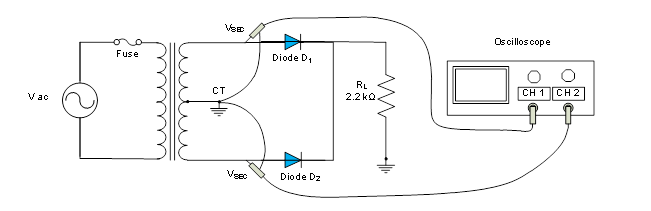
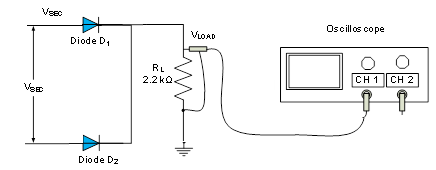
  1. Construct the circuit of a half-wave rectifier in Figure 3 in Multisim. Use a function generator to provide the AC input of Vacand use a center tapped transformer to obtain VSEC. Notice that the ground for the circuit has changed. Check your circuit carefully before applying power.
  2. Connect the Tektronix oscilloscope so that each channel is across each diode. Observe the waveforms VSEC across each diode and then observe the VLOAD.
  3. Connect a 100 μF capacitor (C1) with a tolerance of 20% in parallel with the load resistor (RL). (Note the polarity of the capacitor).
  4. Measure the dc load voltage, VLOAD, and the peak-to-peak ripple voltage, VRIPPLE, of the output. Measure the ripple frequency. Tabulate all data gathered and compare the results with and without the filter capacitor.

figure 3

Figure 3

Hardware (NI myDAQ):

  1. Using twice the voltage VSEC obtained from the simulation, build the circuit in Figure 3 on the breadboard with 2*VSEC as an input, which connects to the two diodes and load resistor RL in series. (See Figure 4)
  2. Using the jumper wires, screw driver and screw terminal connector, connect the board to NI MyDAQ Instrument Device to analyze the circuit.
  3. Use channel AO0 on the NI myDAQ Instrument Device to provide the input (2*VSEC) and channel AI0 to measure the output voltage (VLOAD).
  4. Using the function generator from NI ELVISmx Instrument Launcher, provide the input voltage VSEC to the circuit. Measure the output voltage VLOAD, across the load RL using the oscilloscope.
  5. Repeat steps 3 and 4 with a 100uF capacitor if you notice any variations in the output.

figure 4

Figure 4

Review questions:

  1. What is the purpose of having a full-wave rectifier in the circuit?
  2. Describe the procedure in this lab to arrive at the final design of both the hardware portion and the software portion to achieve the design objectives?
  3. Discuss the impact of having the capacitor on the output voltage and the effect of additional load on the ripple voltage.
  4. How is the output of the full-wave rectifier different from half-wave rectifier?

Deliverables:

  1. Measured voltage VSEC, the output peak voltage, VLOAD and ripple voltage VRIPPLE. Capture screenshots of your measurements from Multisim.
  2. Place your student ID card on the breadboard and take a picture of the circuit board and pin out on the NI myDAQ device.
  3. Capture screenshots of your measurements from the NI ELVISmx Instrument Launcher showing both the input from the function generator and output on the oscilloscope on your screen.

Lab Report:

  • Use the Lab report template found in the “Tools and Template” link in the navigation center.
  • Include all the deliverables from Part A and Part B.
  • Include all the screenshots of the measurements from Multisim, circuit design on the breadboard using NI myDAQ device and measurements from MI ELVISmx Instrument Launcher.
  • Save the document as Lab2YourGID.docx (ex: Lab2G00050331.docx) and submit in Blackboard.

Grading Rubrics

Grading CriteriaPointsPart A: Half-wave rectifier circuit in Multisim – with and without filter capacitor10Part A: Half-wave rectifier circuit on NI myDAQ and breadboard with and without filter capacitor10Part A: Deliverables: Measurements and screen captures from Multisim and hardware15Review Questions10Part B: Full-wave rectifier circuit in Multisim – with and without filter capacitor10Part B: Full -wave rectifier circuit on NI myDAQ and breadboard with and without filter capacitor10Part B: Deliverables: Measurements and screen captures from Multisim and hardware15Review Questions10Report format (Proper use of template)10TOTAL100 

Calculate the price of your order

Choose an academic level, add pages, and the paper type you want.
To reduce the cost of our essay writing services, select the lengthier deadline.
We can't believe we just said that to you.

550 words
We'll send you the first draft for approval by September 11, 2018 at 10:52 AM
Total price:
$26
The price is based on these factors:
Academic level
Number of pages
Urgency
Basic features
  • Free title page and bibliography
  • Unlimited revisions
  • Plagiarism-free guarantee
  • Money-back guarantee
  • 24/7 support
On-demand options
  • Writer’s samples
  • Part-by-part delivery
  • Overnight delivery
  • Copies of used sources
  • Expert Proofreading
Paper format
  • 275 words per page
  • 12 pt Arial/Times New Roman
  • Double line spacing
  • Any citation style (APA, MLA, Chicago/Turabian, Harvard)

Our guarantees

Delivering a high-quality product at a reasonable price is not enough anymore.
That’s why we have developed 5 beneficial guarantees that will make your experience with our service enjoyable, easy, and safe.

Money-back guarantee

You have to be 100% sure of the quality of your product to give a money-back guarantee. This describes us perfectly. Make sure that this guarantee is totally transparent.

Read more

Zero-plagiarism guarantee

Each paper is composed from scratch, according to your instructions. It is then checked by our plagiarism-detection software. There is no gap where plagiarism could squeeze in.

Read more

Free-revision policy

Thanks to our free revisions, there is no way for you to be unsatisfied. We will work on your paper until you are completely happy with the result.

Read more

Privacy policy

Your email is safe, as we store it according to international data protection rules. Your bank details are secure, as we use only reliable payment systems.

Read more

Fair-cooperation guarantee

By sending us your money, you buy the service we provide. Check out our terms and conditions if you prefer business talks to be laid out in official language.

Read more

Why is Purdue Papers the Most Helpful Essay Writing Service for You?

  1. Custom-written and plagiarism-free papers: Our authors create their work from scratch. Before presenting them to clients, we routinely verify them for signs of plagiarism. Our quality assurance group also double-checks and fixes any grammatical errors, assuring that all of our authors adhere to the same standards of writing.
  2. The significance of timely delivery cannot be overstated, and we consistently strive to meet or exceed our clients' deadlines. Regardless of the short time frame, you can count on our writers to get the job done. We always have a team of writers ready to go, even if the deadline is only six hours away.
  3. Customer Satisfaction: Our customer service representatives are the best in the business and have a wealth of knowledge in dealing with clients. All our customer service representatives are trained to listen and reply promptly until you are satisfied with their service. To ensure you're happy, our expert writers will strictly follow the criteria to generate a special report. Our customer service may be contacted by chat, email, or phone. In addition, we provide round-the-clock assistance to all of our clients.
  4. Confidentiality: Our systems are safe, and your information is always protected. We're constantly looking for new facts when it comes to finishing your work. We use a safe and secure payment channel. Since our ordering process is completely anonymous, you don't have to provide any credit card information to place a purchase with us.
  5. Highly Trained Authors: Our writers have received extensive training and are committed to delivering only the best papers. They are fluent in APA, MLA, HARVARD, IEEE, CHICAGO, and AMA referencing styles. To meet your expectations, our skilled writers always pay close attention to your instructions.
  6. Lowered prices: We have set prices that are already discounted. Our prices are the best and affordable for all our esteemed customers.

Let Professionals Take Care of your Academic Paper